TL;DR
I tested UVBrite UltraCleanse for six weeks in a shared family bathroom and on two work trips. It is the only unit on this list that I stopped thinking about — it sits on the counter, it takes about a minute, and the brush head comes out dry-feeling and odour-free. If you want one device that removes the damp-brush problem without a wall bracket, this is the one I keep recommending to patients.
Buy it if
- Households where brushes sit in an open cup next to the toilet
- Anyone with sensitive or bleeding gums who wants to remove one variable
- Frequent travellers who refuse to put a bare brush head in a wash bag
- Parents who need kids to actually use the thing without being nagged
Skip it if
- People who insist on buying from a physical store — it is an online-only offer
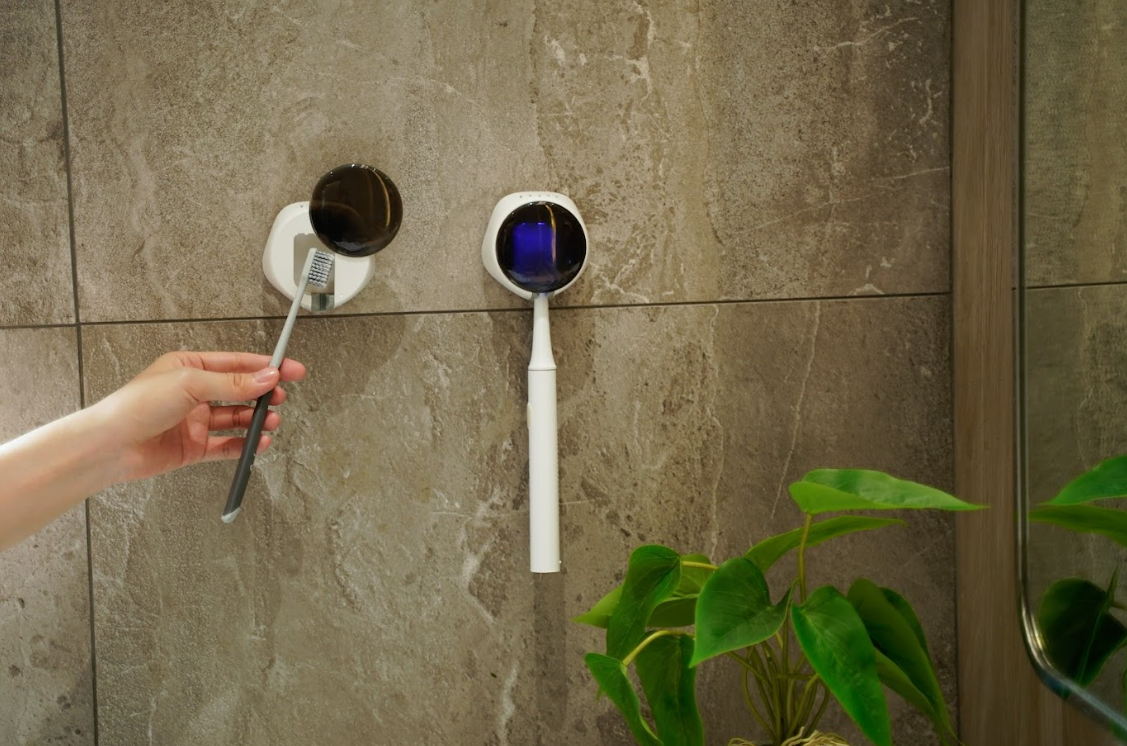
- Anyone who wants a permanent wall fixture rather than a portable case
- Buyers who want to sanitize a full-size electric handle rather than the brush head
Specifications
| Sanitizing method | Enclosed UV-C light chamber |
|---|---|
| Claimed efficacy | Kills 99.9% of germs |
| Cycle length | A few minutes, one button press |
| Compatibility | Standard and electric brush heads |
| Chemicals | None — no sprays, no rinses |
| Also sanitizes | Earbuds, earrings, tweezers, razors |
| Guarantee | 30-day money-back risk-free guarantee |
| Availability | Official online offer only |
Why I bothered testing a toothbrush sanitizer at all
I have spent nineteen years looking inside people's mouths, and the single most common thing I hear when I ask about home care is some version of "I rinse it well." Rinsing is fine for removing paste. It does very little about what actually lives on a brush head between uses: a damp, protein-coated surface parked in a warm room a few feet from a flushing toilet.
The bathroom aerosol problem is not new and it is not fringe. Every time a lid-open toilet flushes, fine droplets travel further than most people expect, and an uncovered brush is an efficient landing pad. Add the moisture that never fully leaves the bristle base and you have a surface that stays hospitable to bacteria for hours.
So I was not testing UVBrite because I think toothbrushes are dangerous. I was testing it because reducing the bacterial load on something you put in your mouth twice a day is cheap, passive risk reduction — if the device actually works and if you actually use it.
What arrived and what the first week felt like
UltraCleanse is smaller than I expected — genuinely pocket-sized rather than 'compact' in the marketing sense. You drop the brush head in, close it, press once, and walk away. There is no app, no pairing, no display to read. That matters more than it sounds, because the failure mode of every hygiene gadget is that people stop using it by day nine.
The first thing I noticed was not clinical. It was the smell, or the absence of it. A brush that lives in a closed, sanitized chamber does not develop the faint sour note that a brush in an open cup does by the end of a week. My partner noticed it before I mentioned I was testing anything.
The second thing was behavioural. My two kids, who treat brushing as a negotiation, started asking to use "the light box." I did not have to explain UV-C to a seven-year-old. That is a real adherence advantage over any device that lives on a wall above their reach.
How UV-C sanitizing actually works
UV-C is short-wavelength ultraviolet light. It does not burn or chemically dissolve anything; it damages the nucleic acids inside bacteria and viruses so they can no longer replicate. This is the same principle used to treat municipal water, sterilize equipment in hospitals, and keep water systems safe on the International Space Station.
Two things determine whether a UV-C device does anything useful: dose and line of sight. Dose is intensity multiplied by time, which is why a proper cycle takes minutes rather than seconds. Line of sight matters because UV-C does not bend around corners — bristles that are shadowed get less exposure than bristles facing the lamp.
UltraCleanse handles this the sensible way: a small, fully enclosed reflective chamber sized to a brush head, so the light bounces rather than escaping. The enclosure is also the safety mechanism — the lamp runs inside a closed case, not in the open air where it could reach your eyes or skin.
Living with it: the six-week log
Weeks one and two, I ran it after every brush, twice a day. That is the intended use and it is easy because the cycle is shorter than the time it takes me to floss. Weeks three and four, I deliberately dropped to once daily to see whether the difference was noticeable. Honestly, it was not — the brush still felt clean and dry-based. Once a day is a defensible routine for most people.
Weeks five and six covered two trips. This is where the format wins. A brush head in a hotel bathroom is exposed to a room you did not clean, and the alternative — a plastic travel cap over a wet brush — is arguably worse than leaving it out, because you have created a sealed humid box. Sanitizing then storing in the same unit removes that trade-off entirely.
Charging was a non-event. I plugged it in once before the first trip and did not think about it again during the test window.
Where I saw a difference — and where I did not
I want to be precise about claims. I am not running plate cultures on my kitchen counter and I am not going to pretend I measured colony-forming units. What I can report is the practical, observable stuff over six weeks: no musty odour, no slimy film at the bristle base, and a brush that visibly dries rather than staying damp in a covered cup.
On the clinical side, the honest answer is that a sanitizer is not a treatment. It will not fix gingivitis, it will not replace flossing, and it will not compensate for a brush head you have kept for eight months. What it does is remove one recurring source of reintroduced bacteria from a routine you already perform.
My patients with sensitive gums are the group I would push hardest toward it, because they are the ones for whom a small reduction in daily irritants tends to be noticeable within a couple of weeks.
The things I did not like
It is online-only. You cannot walk into a store, look at it, and take it home the same afternoon. For some people that is disqualifying, and I would rather say it plainly than bury it.
The pricing is promotional. The official offer currently shows a 50% discount against the regular price, and promotional pricing by definition is not guaranteed to be there in a month. If you are the sort of person who resents buying into a countdown, that will grate.
It sanitizes brush heads, not entire electric handles. If you use an electric toothbrush, you detach the head and drop it in. That is the correct way to do it anyway, but it is an extra second of handling.
Care, durability and the boring maintenance question
There is almost nothing to maintain. Wipe the inside of the chamber with a dry cloth occasionally so that toothpaste residue does not build up on the reflective surface — residue blocks light, and blocked light means a weaker dose. Do not run it with a dripping-wet brush head if you can help it; a quick shake first keeps water out of the chamber base.
Do not attempt to open the housing to look at the lamp. The enclosure is the safety system. If the unit ever stops lighting, that is a warranty conversation, not a repair project.
Battery-wise, the honest expectation for any small rechargeable device is a slow decline over years rather than a sudden failure. Charge it when convenient rather than running it flat every time.
Price, guarantee and what you are actually buying
At the time of writing, the official offer shows a regular price of $88.87 discounted to $44.43 for a single unit — a 50% saving — with fast US shipping and a 30-day money-back risk-free guarantee. Prices on promotional offers move; check the offer page before ordering.
The guarantee is the part I would actually lean on. A month is long enough to find out whether you will keep using it, which is the only question that matters with a device like this. If it ends up in a drawer, send it back.
Compared with the Amazon alternatives further down this page, you are paying more than the budget wall units and roughly in line with the premium ones. What you get for that is the format: a sealed portable chamber rather than a bathroom fixture.
Alternatives worth considering
If you specifically want a wall fixture and never travel, the Bril holder is the mature product in that category and has by far the largest review base. If you want the brush dried as well as sanitized, PhoneSoap's unit adds a fan. Jetfresh gives you drying plus a clock display, and iHave is the budget entry that auto-cycles on a timer.
All four are reasonable purchases. None of them solve the travel case, and none of them double as a sanitizer for earbuds and small personal items, which is the argument for UltraCleanse.
The verdict
UVBrite UltraCleanse earns the top spot because it is the unit people keep using. The cycle is short, the format is portable, the safety design is sensible, and there is a 30-day guarantee behind it. The online-only distribution and the promotional pricing are real drawbacks and I would not pretend otherwise.
If you have been meaning to do something about the state of your toothbrush for a while, this is the one I would start with.
Alternatives
- #2 Bril UV-C Toothbrush Sanitizer and Holder
A permanent spot on the bathroom wall
- #3 PhoneSoap UV Toothbrush Sanitizer, Dryer & Travel Case
People who want the brush dried as well as sanitized
- #4 Jetfresh UV Toothbrush Sanitizer Holder & Cleaner
A shared family bathroom wall
- #5 iHave Toothbrush Sanitizer Wall Mount
A second bathroom on a tight budget